The Future of Marketing: Understanding AI’s True Impact On Marketing
The initial excitement over chatbots and automated email sequences in marketing has faded. The question is no longer “Will AI be part of our strategy?” but “What is AI’s true impact on marketing, and how can we use it to its full strategic potential?”
We need to look beyond the headlines about productivity gains and automation to understand the future of marketing. The real change is in the way marketing works: AI is not meant to replace people, but to improve them, turning marketers from tactical doers into strategic visionaries.
Read Before: How to Use ChatGPT’s App Integration: New Spotify, Figma, and Canva
A lot of businesses use AI to make things more efficient, like scheduling posts, writing simple copy, or entering data. These apps are useful, but they only show a small part of what they can do. The real value of AI isn’t in automating simple tasks; it’s in its ability to process data at a speed and scale that no human team could ever match.
The Change from Doing Tasks to Generating Insights
Modern AI tools, especially those that use machine learning and large language models (LLMs), are great at generating insights. They can look at billions of data points, customer journeys, sentiment analysis, purchase histories, and what competitors are doing, and give marketers real-time, useful information.
This feature changes the marketing department’s focus. The AI’s true impact on marketing is that it can handle data synthesis, which lets human teams focus on strategy.
Changing the Marketer’s Role: Strategy Instead of Repetition
The end goal of this technological progress is to make the workforce more efficient. AI takes care of boring, repetitive, and predictable tasks, which lets human marketers focus on things that machines can’t do, like high-level strategy, deep creative empathy, brand storytelling, and building complex relationships.
In the future, the best marketing teams won’t be the ones who can make content quickly. Instead, they’ll be the ones who can come up with a good AI marketing strategy that strikes a balance between machine efficiency and real human connection.
The Hyper-Personalization Engine: “AI’s Most Important Feature” of AI’s True Impact on Marketing
There is no doubt that AI has a positive effect on one area: the ability to deliver hyper-personalization on a large scale, which was just a dream a few years ago.
Segmentation in real time and predictive analytics
AI’s true impact on marketing is seen in how it can go from broad demographic segmentation (like “Women aged 25–35”) to microsegmentation based on real-time intent and predicted behavior.
AI algorithms can find small patterns in data about browsing, clicking, and buying to guess
- What a customer might buy next.
- When they are most likely to change.
- What message will hit home the hardest right then and there?
This level of accuracy is the key to getting the most out of Marketing ROI with AI, since it cuts down on money spent on outreach that doesn’t work.
The Creative Collision: AI That Makes Things and People Who Watch Over It
The rise of generative AI has made creative departments both excited and worried. Machines can write text, code, and pictures in seconds, but the most important question is: Does it have creativity?
Finding the Brand Voice: Speed vs. Authenticity
Generative AI is a great way to come up with ideas and speed up the process of making and testing new content. But it needs a human curator to keep the brand voice consistent and real. AI can write text quickly, but only a person knows the emotional context, cultural subtleties, and long-term story that are needed to build real brand equity. The best campaigns will be the ones where the marketer uses AI to make ten different versions of a message, but only the human chooses and improves the one that fits with the brand’s deep empathy.
The New Imperative: Humans Curate Content Made by AI
It’s important to remember that generative AI is a partner, not a replacement, for the future of digital marketing. Marketers need to become great editors and curators because they are in charge of adding the unique emotional touch that turns short-term interest into long-term loyalty. This important oversight role is what makes AI-powered marketing work instead of just being automated noise.
How to Deal with the Moral Issues of AI-Powered Marketing
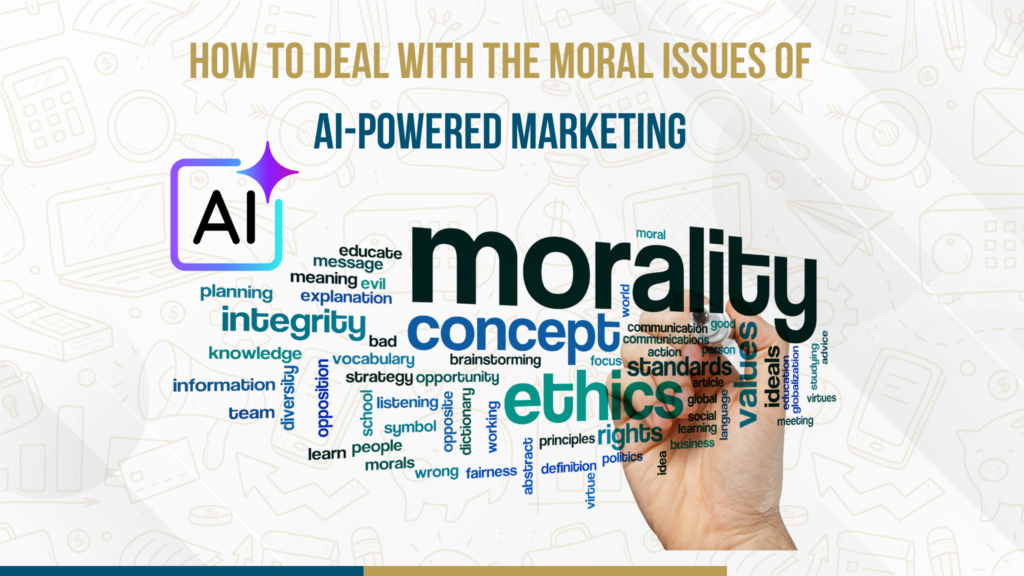
Understanding the ethical challenges of AI-powered marketing is essential for building trust and responsible digital strategies.
You can’t have a full discussion about AI’s true impact on marketing without talking about the ethical framework. As AI gets better at collecting data and making predictions, marketers have to be more open and fair.
Keeping Customer Trust, Data Privacy, and Bias
The quality of AI depends on the data it learns from. If that data is biased, the marketing results will reinforce that bias, which could turn off whole groups of people in your audience. Also, people are becoming more cautious about how their information is being used. Marketers need to put ethical AI use first. This means that data collection should be clear, and personalization should never go too far and make people feel uncomfortable or “creepy.”
The Most Important Thing For Conversion is Openness.
In a future driven by AI, the most important thing for conversion is keeping customers’ trust. Customers will be loyal and stay engaged with brands that are open about how they use AI, explain how personalization works, and let customers control their own data.
In conclusion, We Need to build a Future Of Marketing That is Driven By AI and Led By People.
AI’s true impact on marketing isn’t to make the marketing department smaller; it’s to make it more important strategically. AI takes care of the hard parts, so people can focus on creativity, ethics, and strategic direction. The agencies and internal teams that do well will be the ones that learn how to work together, using the machine for accuracy and the person for purpose.
If your company is ready to go beyond basic automation and set up a complete, moral, and high-ROI AI strategy in marketing, you need expert help to find your way in this new, exciting world.