What Happened to Google People Cards? Rise, Fall, and Impact on Digital Visibility
Google then introduced a new feature in August 2020, which is available mostly in emerging markets such as India, called Google People Cards (also called the Add Me to Search feature). The idea behind the vision was groundbreaking: to enable people to build their own Digital Business Card, see it right in the search results of Google, which could be regarded as a mini-Knowledge Panel created by the user.
Entrepreneurs, freelancers, and influencers were excited. However, the feature was soon retired, and Google announced this after a brief and successful run. The question that every digital marketer and an individual who is concerned with personal branding would ask is: What has happened to Google People Cards, and, more crucially, what will replace this tool to achieve dominance in search results?
The Rise: How Google People Cards Changed Search
The introduction of Google People Cards was aimed at addressing a major issue, especially in areas where most professionals lacked or had a poor digital presence.
A Virtual Visiting Card
The People Card was a digital profile, which the user could use to authenticate their identity with a mobile number and fill in the fields such as:
- Name, Place of residence, and Work.
- A brief “About Me” section
- Connection to websites, social profiles, and other important media.
The card was tailored to come out at the top of the Google search when an individual searched the name of the person. It was a breakthrough, particularly to those with common names who were able to now stand out and grab a high-ranking presence.
The Digital Identity Impact
The aspect was an enormous personal branding advancement. It offered an easy way of searching recognition that did not involve the old, tricky demands of creating a website and learning SEO. To millions of people, it provided some instant credibility and one source of truth for their professional information. The People Card was used temporarily as the least complicated method of making sure that the links and information of an individual appeared on the first page of the search results (SERP).
The Fall: The Reason the Feature was dropped
Although it was popular, especially in launch markets such as India, South Africa, and Nigeria, Google officially shut down Google People Cards on April 7, 2024.
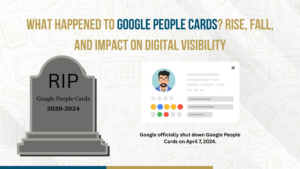
Google People Cards shut down and its impact on online visibility.
The explanation given by Google was that the feature was not of use to the people as much as they would have imagined. Nonetheless, the reasons the retirement gives are probably the technical and logistical difficulties:
- Complexity of Identity Verification: It is extremely complicated to scale a feature based on the authentication of Digital Identity on a global scale. Although the authentication of phone numbers was mandatory, combating spam, abuse, and impersonation was a wicked waste of resources for Google.
- Smartphone-only limited global adoption: The feature itself did not see widespread use beyond its original test markets, which restricted its overall usefulness to the global search engine.
- The Knowledge Graph Overlap: The Knowledge Panel system, which Google currently utilizes to display authority figures and brands, started overlapping its existing power with the function of the People Card. Self-curation of a card by the users probably caused discrepancies in the internal authority pointers of Google.
The shutdown was a bitter lesson to the marketers that it is dangerous to be dependent on a single, non-core platform feature. Google is continuously appraising and discarding tools that fail to deliver sufficient, scalable value to shift funds to more useful projects.
The Pivot of SEO and Personal Branding (Post-People Card)
The death of the Google People Cards option implies that marketers and individuals have to revert to the conventional, long-term SEO options in order to gain online presence. In the case of the best digital marketing company in Delhi, such as National Marketing Projects, this change highlights the importance of having your online space.
The Strength of the Personal Website
The final non-negotiable option is the personal website or portfolio. It provides full control of branding, content, as well as data.
- SEO Strategy to be followed: Add the Schema Markup (Person and ProfessionalService schema) to your About Me page. It is this organized information that makes Google recognize you as an entity, and this is the process that you will need the Knowledge Panel (which the People Card was mocking) in time.
- Content Authority: Post thought leadership content, case studies, and a powerful professional bio on your site.
Professional Profile Optimization (The Core Links)
As far as you can not rely on an Add Me to Search card to list your links, you have to maximize on the links that Google does prioritize:
- LinkedIn Mastery: Make sure you have optimized your LinkedIn profile with your desired job title and location. LinkedIn profiles are often top in name searches.
- Credible Directories: Get your profiles on high Domain Authority sites related to your industry (e.g., industry-related organizations, university directories).
- Unified NAP/Citations: Use the same Name, Address, Phone, and Credentials (NAP/C) on all platforms.
The Authority and Earned Media Power
In order to gain a real digital presence, you need to possess authority and trustworthiness (E-A-T).
- Guest Posting: Post valuable articles to the well-known publications in the industry with the referrals back to your own site. Such high authority backlinks are indicators of relevance to Google.
- Speaking Engagements: Post the profile of your speaking engagements, interviews, and mentions in the media on your site. Google considers these cues to be evidence of Expertise and Authority.
Legacy and Lessons Learned
The experiment of the Google People Cards taught me a lesson on the dynamic quality of the digital marketing environment. It showed how Google is ready to make experiments, especially to fill the accessibility gaps in emerging markets.
The moral of the story is that being the master of your own presence is the sole long-term plan to digital marketing success, and having a presence that is well-established and credible in terms of its content is the only key to such dominance. Functionalities come and go, however, the good old Digital Visibility, with the principles of SEO, is the most sure way of taking control over your narrative and to make sure that your clients can always find you.